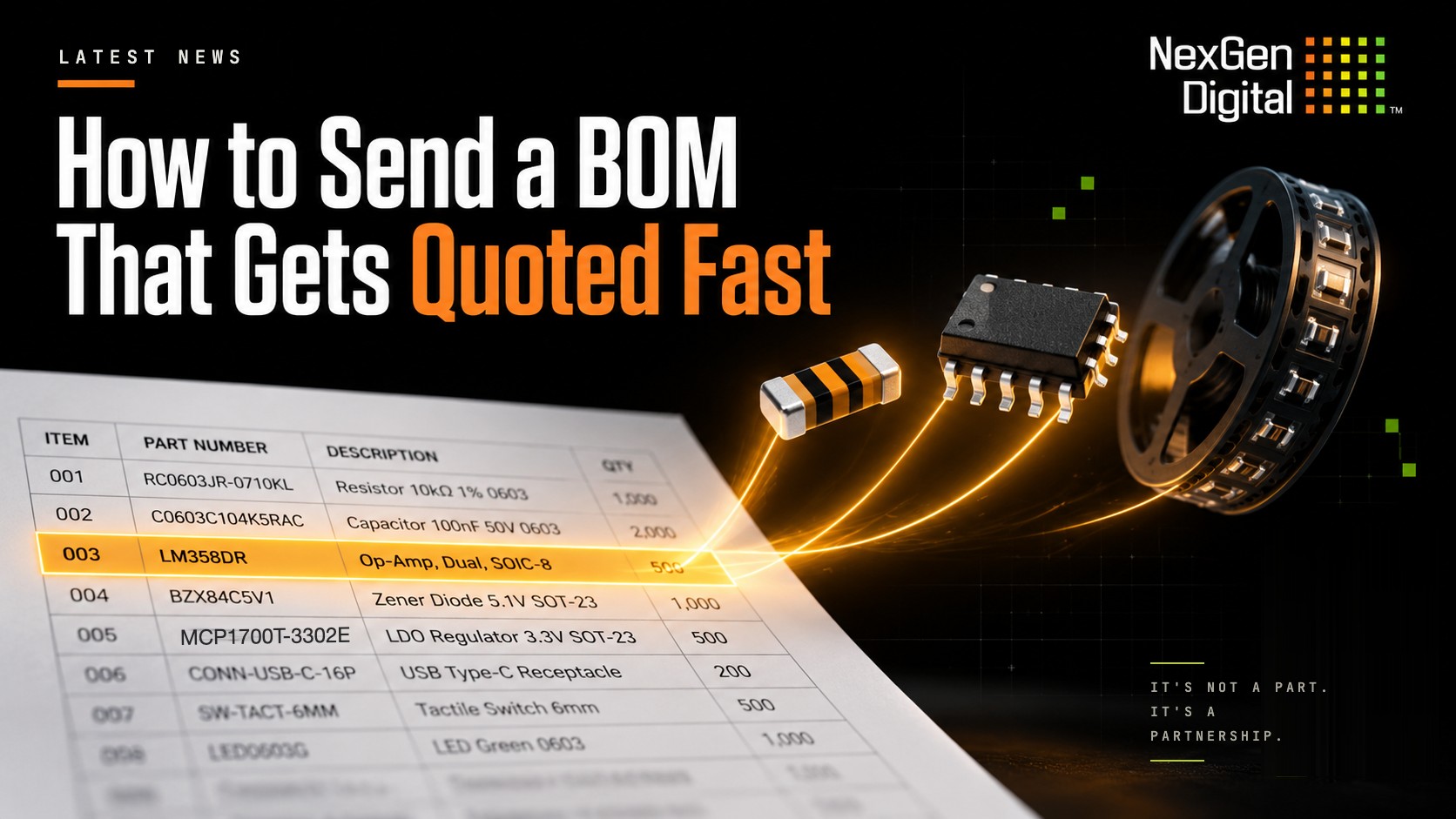
Send a BOM as a file, with the manufacturer part number, quantity and target date on every line, and say up front what you will and will not accept. That is most of what gets it quoted fast. This guide covers what to include, what to leave out, and the handful of habits that quietly add days to a quote. It is written by the people at NexGen Digital, Inc. who open those files in Irvine every morning.
None of it is complicated. Most of it is the difference between a quote by lunch and a quote after three emails asking what you meant.
The short version
- Send a file, not a screenshot. Upload it on the contact page as .csv, .xlsx, .xls, .xlsm or .pdf.
- Put the manufacturer part number, quantity and need-by date on every line. Those three do most of the work.
- Tell us before we ask: alternates yes or no, minimum date code, country-of-origin limits, reels or cut tape.
- Send the whole BOM, not just the lines that hurt. The context changes the answer.
- Give us one name on your side. Quotes stall in shared inboxes.
Send the file you already have
Your BOM already exists somewhere: an ERP export, a spreadsheet the engineer built, a PDF the contract manufacturer sent back. Send that. You do not need to clean it up, rename the columns or move things around to match a template. We read every format a purchasing system can produce, and a few it should not.
The order of preference is simple. A spreadsheet (.xlsx, .xls, .xlsm) or .csv is fastest, because the part numbers can be checked without being retyped. A PDF is fine, and slower, because somebody has to transcribe it before anything else can happen. A screenshot of a spreadsheet, or a photo of a screen taken with a phone, is the slowest thing you can send. We have quoted from those. We would rather not.
If the BOM lives in an email thread, attach it anyway. A file in the email body is not a file.
The five columns that do most of the work
You can send us forty columns. These are the five that move the quote.
Manufacturer part number, exactly as printed. Including the suffix. On many parts the suffix is the part: it sets the packaging, the temperature grade, the plating, the tape orientation. A number with the tail cut off is a question, not a line item, and it goes back to you as one.
Quantity. Per build, and how many builds if you know. A one-off prototype run and a scheduled monthly delivery are sourced differently, priced differently and sometimes bought from different places.
Need-by date. A real date, not “ASAP”. “ASAP” tells us you are in a hurry. A date tells us whether air freight from a partner warehouse makes sense or whether a slower, cheaper route still lands in time.
Manufacturer. The maker, not the distributor you bought from last time. When two manufacturers share a part number, and they do, this is what stops the wrong one being quoted.
Your internal part number and description. Optional, and it earns its column. When a manufacturer part number has a typo in it, the description is how we catch it before the quote goes out with the wrong part on it.
Say what you will accept before we ask
Every hard line on a BOM ends in one of two conversations: we found it, or we found something close. The second conversation goes much faster if you have already told us what “close” is allowed to mean.
- Alternates. Will you take a manufacturer-approved cross? A different package of the same die? A different supplier entirely? “Alternates OK with approval” is a perfectly good answer, and it lets us quote both.
- Date codes. If you have a minimum, say so on the line. Some programs will not accept anything older than two years. Others do not care. We cannot guess which you are.
- Country of origin. If your customer, your contract or your compliance team restricts where a part can come from, tell us up front. It changes which stock we look at.
- Packaging. Full reels only, or is cut tape fine for the short lines? Tubes, trays, bulk? Minimum order quantities on a reel can turn a 40-piece need into a 2,500-piece quote if nobody says otherwise.
- Finish and compliance. RoHS only, or is tin-lead acceptable? Some aerospace and defense builds need it. Most commercial builds cannot have it.
- Traceability. Factory-direct paperwork required, or is open-market stock acceptable when it goes through our lab first? Both are legitimate answers. They lead to different quotes.
A column called “Notes” with one word in it, like “no alternates” or “cut tape OK”, saves more time than anything else on this page.
Send the whole BOM, not just the lines that hurt
Buyers often send us the three lines their franchised distributor could not fill, and keep the rest. We understand why. But the three hard lines make more sense with the other forty around them.
Sometimes the “easy” lines have quietly moved to allocation since the last order and are about to become hard lines. Sometimes we hold the easy lines too, and one shipment beats four. And sometimes a hard line has an alternate that only works if we know what sits next to it on the board. Send the whole thing. We will quote what we can, say clearly what we cannot, and not pretend the difference away.
What quietly adds days when you send a BOM
None of these are crimes. All of them cost time.
- Part numbers with the suffix missing, or “or equivalent” written after them with no definition of equivalent.
- A quantity of “TBD”. We can quote price breaks. We cannot quote a shrug.
- The BOM typed into the body of the email. It has to be pulled out again line by line.
- Ten lines across ten separate emails, each with a different subject.
- “Urgent” with no date. Everything is urgent. A date is information.
- Sending the same BOM to five brokers at once with no target and no notes. It is your right. It also tells all five the same thing, and the response you get back is priced accordingly.
What happens on our side
When you send a BOM, a person opens it. Not a parser. They read every line against stock we hold, stock our partners hold across North America, Europe and Greater China, and the open market when franchise channels have run dry. They flag what needs a conversation: a date code restriction, a manufacturer that has gone end-of-life, a quantity that only exists as a full reel.
You get a quote with that person’s name and direct line on it. If a line is going to take longer because it has to be sourced and verified, the quote says so instead of going quiet. And every part we ship, on every line, goes through our own lab in Irvine before it leaves. That is not a line item you have to ask for. It is how the building works.
A worked example
Here is what a well-written line looks like. Not a real quote, just the shape of one.
- MPN: LM317T (Texas Instruments)
- Qty: 1,200 per build, 3 builds
- Need by: 15 October
- Notes: alternates OK with approval, date code 2024 or newer, tube packaging fine, RoHS only
That is how to send a BOM that gets quoted without a single follow-up question. Multiply it by however many lines you have and you will get the fastest quote we can give.
Upload it on the contact page, or email it to info@nexgendigital.com. Either way a person opens it.
Questions people ask us about BOM quotes
A bill of materials is the complete list of parts needed to build a product, with a quantity for each. In electronics it usually lists the manufacturer part number, manufacturer, description, quantity per board and reference designators. Distributors quote from it line by line.
Spreadsheets (.xlsx, .xls, .xlsm), .csv files and PDFs, uploaded through the form at nexgendigital.com/contact or emailed to info@nexgendigital.com. Spreadsheets and .csv files are quoted fastest because the part numbers do not have to be retyped.
No. A target price is helpful when you have one, because it tells us which sourcing routes are worth pursuing, but it is not required. Part number, quantity and need-by date are the three fields that matter most.
Yes. Many customers send only the lines their franchised distributor could not fill. Sending the full BOM is still better: it gives context for alternates, lets shipments be combined, and catches lines that have moved to allocation since the last order.
It depends on the lines. Parts held in stock or with partners are quoted quickly. Hard-to-find, end-of-life or allocated parts take longer because they have to be sourced and verified before a price is real. The quote tells you which lines are which rather than holding everything back.
Yes. Every part NexGen Digital ships is inspected in its own lab at 1370 Reynolds Avenue, Irvine, California before it leaves, with testing to AS6171 methods when the part or the customer requires it.