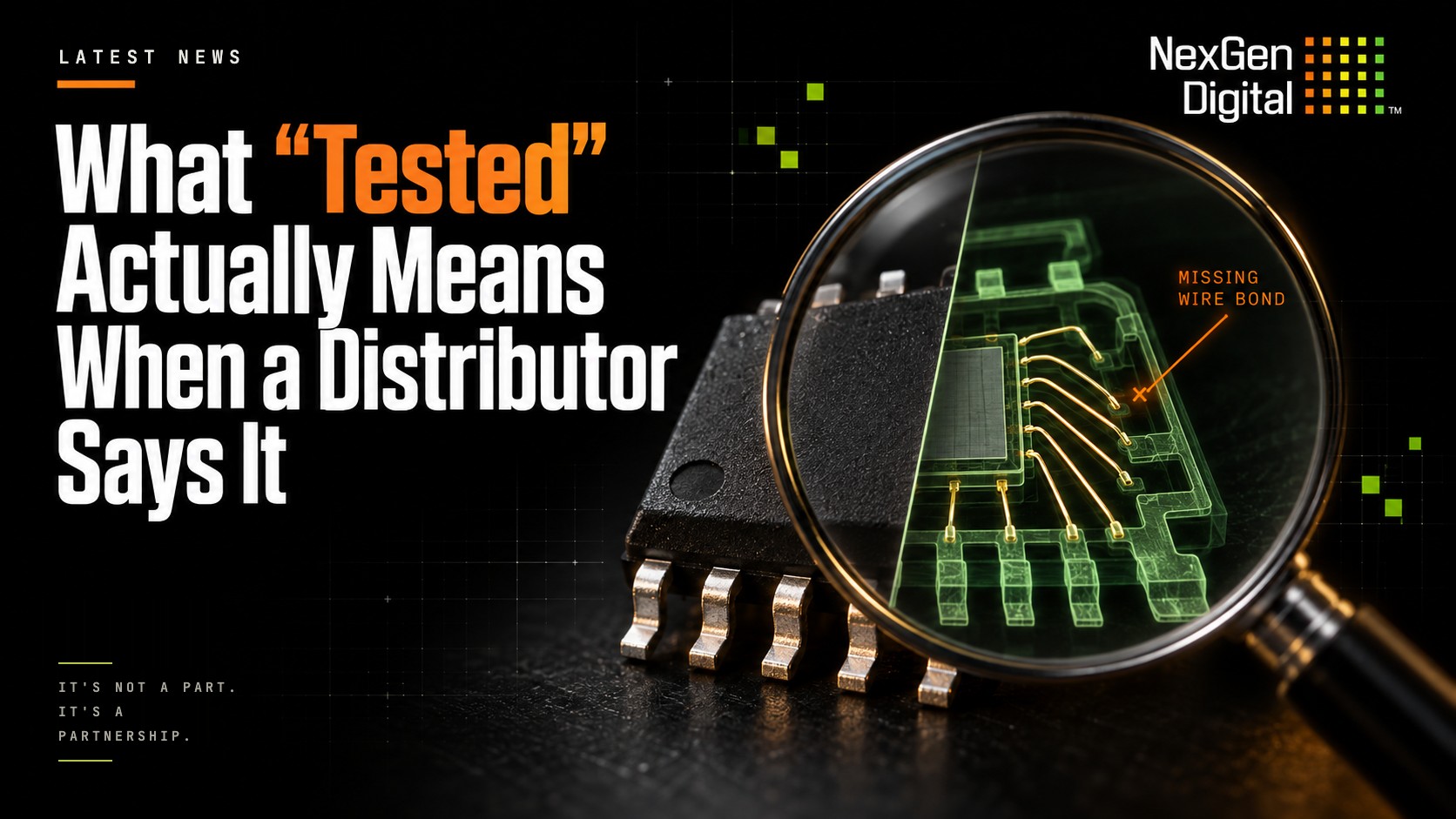
When an electronic components distributor says a part is “tested”, it can mean anything from a glance at the label to a full AS6171 counterfeit testing plan. At NexGen Digital, Inc. every part passes through our own lab in Irvine, California before it ships. This is what happens in that lab, test by test, what each test catches, and what the standards on our wall actually commit us to.
It is longer than a bullet on a line card. That is rather the point.
The short version
- No single test proves a part is genuine. Counterfeit testing is a sequence of tests, chosen for the part and the risk, that gets you to something a person can sign.
- The sequence runs from the outside in: paperwork and packaging, then the microscope, then X-ray and XRF, then inside the package, then electrical.
- AS6081 governs how a distributor avoids counterfeits. AS6171 governs how a lab tests for them. We work to both, and the difference matters.
- We do it in-house because a part that fails should fail here, on our bench, not on your line three weeks later.
Why the word needs unpacking
A counterfeit is rarely a fake in the movie sense. More often it is a real part that is lying about something. A used part pulled from scrap boards, cleaned and sold as new. A lower-grade part re-marked as the industrial or automotive version. A part with the right markings and the wrong die inside. A blank package with no die at all, which sounds absurd until you have seen one.
A different test catches each of those lies. Which is why “we test our parts” is not an answer. The question is which tests, on which parts, decided by whom, and what happens when one fails. What follows is our answer to that question.
Before the part: paperwork and packaging
Testing starts before anyone touches a component. Where did this lot come from? Which vendor, vetted how, with what history? What traceability arrived with it, and does the paper chain make sense? A certificate of conformance that names a manufacturer who never made the part in that package has ended more than one purchase before the box was opened.
Then the box itself. Manufacturer labels, lot codes and date codes that agree with each other and with the reel or tray inside. Sealed moisture barrier bags, with a humidity indicator card that has not turned. Trays that match the manufacturer’s drawing. Packaging is cheap to fake badly and surprisingly hard to fake well, so it is where a lot of problems first show themselves.
Under the microscope: visual inspection and marking permanency testing
Counterfeit testing proper starts with external visual inspection to IDEA-STD-1010, the industry standard for inspecting electronic components, under stereo and binocular metallurgical microscopes. The inspector is looking for things a person at a desk cannot see: marking fonts and logo shapes that are slightly wrong, a surface texture that differs between the top and the sides, sanding marks under a new coat of black paint, indentations that are too shallow or too sharp.
Leads get their own look. Are they coplanar, so the part will sit flat when soldered? Is the finish consistent across the lot, or did somebody re-tin a few? Do the dimensions match the datasheet? Then the marking permanency tests: solvent resistance, and an acetone and scrape test that lifts re-marked ink and coatings the way the original marking would never lift. If the part number comes off on a swab, the conversation is over.
Seeing inside without opening it
X-ray inspection shows the internal structure: the size and position of the die, the wire bonds, the lead frame. Across a lot, those should be consistent. A tray where half the parts have a different die size is a tray with two different parts in it, whatever the markings say.
XRF, X-ray fluorescence, reads the elemental composition of the lead finish and plating. It answers a compliance question, whether the finish is lead-free for RoHS builds or contains the tin-lead some aerospace and defense programs require, and an authenticity question, because a plating that does not match the manufacturer’s specification is a plating somebody else applied.
Opening it up
Decapsulation removes the package material over the die so we can examine the die itself. The manufacturer etches its logo, part identifiers and die revision markings into the silicon, and no laser can re-mark them. A heated chemical test on the package surface does the same job from the outside, revealing resurfacing that survived the acetone. Decapsulation destroys the sample, so we run it on a sample size chosen for the lot and the risk, not on every part.
Does it actually work: solderability, electrical and functional testing
The last group of tests asks the simplest question. Solderability testing, by dip-and-look or wetting balance, confirms the leads will take solder the way new leads should; old or refinished parts often will not. LCR testing measures passive components against their stated values. Electrical testing checks parametric values against the datasheet. Functional testing exercises logic and operational behavior for the parts where that matters.
When the part or the customer calls for it, the whole plan runs to AS6171 methods, the standard that defines how to perform each of these tests and how to put a risk-based test plan together.
What the standards mean in plain words
Websites list certifications like trophies. They are more useful as a description of which audits a company has agreed to sit.
- AS6081 is the SAE standard for distributors: how to avoid, detect, mitigate and dispose of counterfeit parts in an independent supply chain. It is about the process, from vendor vetting to quarantine.
- AS6171 is the SAE standard for test laboratories: the test methods themselves and how to build a risk-based plan from them. AS6081 says test. AS6171 says how.
- AS9120B is the aerospace quality management standard for distributors, covering traceability, record keeping and control of the parts in stock.
- ISO/IEC 17025 is the accreditation for testing laboratory competence: calibrated equipment, qualified people, documented methods.
- ANSI/ESD S20.20 covers electrostatic discharge control, so the parts are not damaged by the people inspecting them.
- DLA QTSL and QSLD are the Defense Logistics Agency’s qualified lists for testing suppliers and distributors.
The bodies we belong to
- ERAI collects and shares reports of counterfeit and non-conforming parts across the industry. Membership means we report what we find and we read what others report.
- GIDEP is the Government-Industry Data Exchange Program, which circulates alerts on suspect parts and suppliers.
- IDEA is the Independent Distributors of Electronics Association, which publishes the inspection standard our visual inspection follows.
- ITAR registration means we are registered with the US State Department to handle defense-related articles and data.
NexGen Digital holds all of the above. The full list is on the quality assurance page, and any of them can be verified with the issuing body, which is the point of them.
Why we do counterfeit testing in-house
Plenty of distributors send parts out to a third-party lab, and a good third-party lab is a good thing. We built our own for two reasons.
The first is time. A part that fails at an outside lab has already cost you the transit there, the queue, the transit back and the phone call. A part that fails on our bench costs you an email, sent the same day, before the replacement search has even had time to go cold.
The second is accountability. When the person who inspected your parts sits down the hall from the person who quoted them, there is nowhere for a problem to hide between departments. The report has a name on it, and that name answers the phone.
There is a third reason, which is less comfortable to say out loud. Sometimes the best result from testing is a part you never receive. A rejected lot is not a failure of the service. It is the service. We would rather explain a rejection than explain a field return.
What you get with the part
Every part ships with the inspection it received behind it. If you want the report, the photographs and the X-ray images for your lot, ask your account manager. They exist because the work happened, and they are yours.
If you have a program with its own test requirements, send them with the BOM. It is much easier to build the plan in before the parts arrive than to argue about it after.
Questions people ask us about testing
Yes. NexGen Digital inspects every part it ships in its own lab at 1370 Reynolds Avenue, Irvine, California. The depth of counterfeit testing is set by the part and the risk: external visual inspection to IDEA-STD-1010 as a baseline, with X-ray, XRF, solderability, decapsulation, LCR, electrical and functional testing added as required, and full AS6171 test plans when the part or the customer specifies them.
AS6081 is the SAE standard for distributors and covers the process of avoiding, detecting and handling counterfeit electronic parts, from vendor selection to quarantine and reporting. AS6171 is the SAE standard for test laboratories and defines the test methods and how to assemble a risk-based test plan. NexGen Digital is certified to AS6081 and tests to AS6171 methods.
A counterfeit electronic component is a part that misrepresents what it is: a used part sold as new, a lower-grade part re-marked as a higher grade, a part with the wrong die inside a correctly marked package, or a package with no die at all. A different test detects each type, which is why counterfeit testing uses a sequence of tests rather than a single check.
IDEA-STD-1010 is the inspection standard published by the Independent Distributors of Electronics Association. It defines the acceptability criteria and procedures for external visual inspection of electronic components, including markings, leads, package condition and packaging.
Yes. Inspection reports, photographs and X-ray images for a lot are available on request from your NexGen Digital account manager.
Turnaround and accountability. We report a failure found in-house the same day, without transit or queue time, and the people who inspect the parts work alongside the people who source and quote them, so a problem cannot fall between two companies.