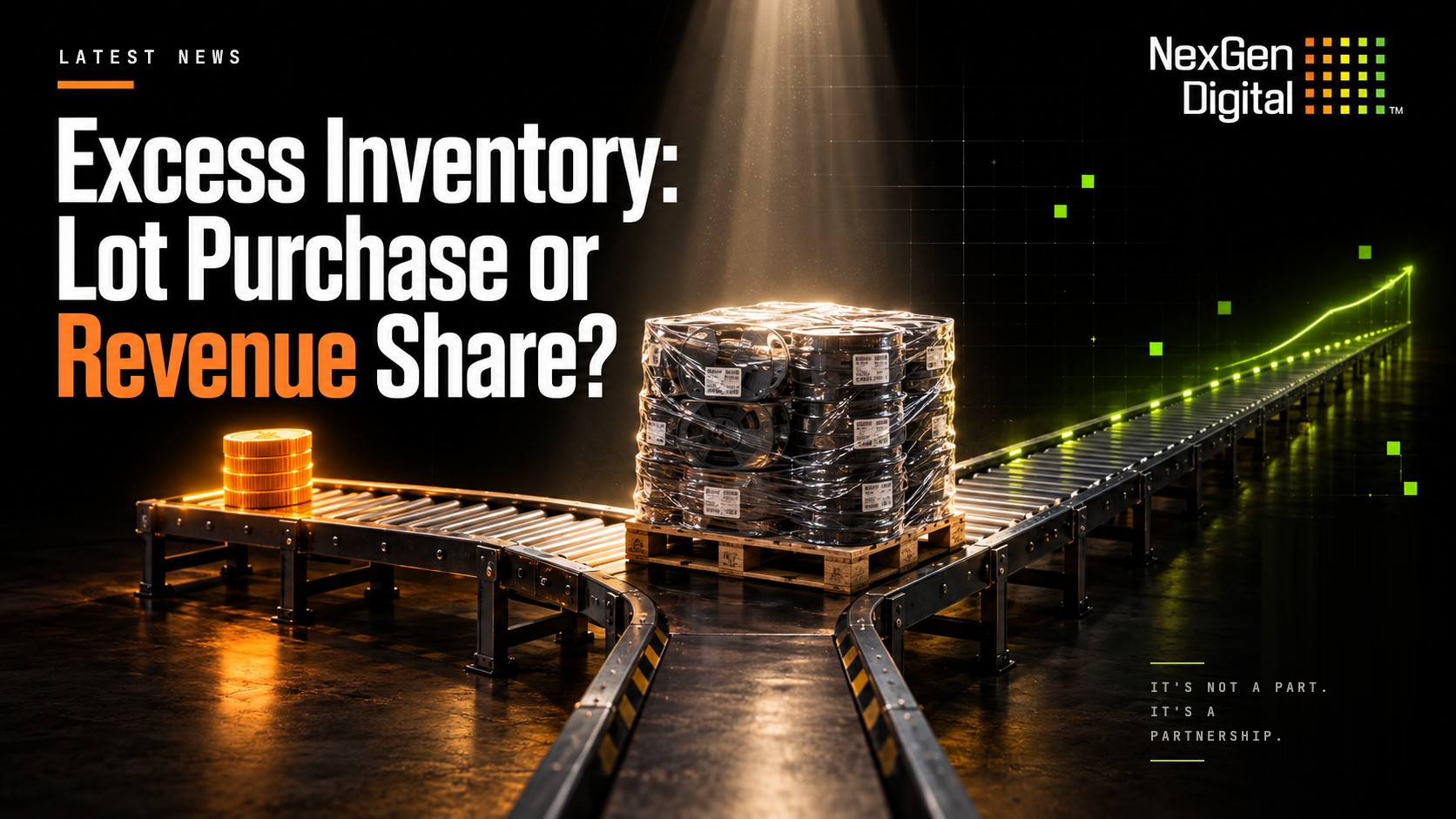
There are two ways to turn excess inventory into revenue: sell the whole lot of electronic components to a distributor for a single payment, or put it on revenue share, where the distributor sells it for you over time and you split the proceeds. NexGen Digital, Inc. offers both through NexCess. This guide explains how each route works, what you give up and gain with each, and how to decide, line by line, which one your pallet deserves.
Short answer for the impatient: most pallets want both.
The short version
- Lot purchase: we buy it, one payment, gone. Fastest and cleanest. The price reflects the risk we take on.
- Revenue share: you keep ownership, we hold and market the stock, and we split the revenue when it sells at market value. No upfront cost. Slower, and usually worth more for the right parts.
- Commodity lines tend to suit a lot purchase. Hard-to-find, allocated and long-lifecycle parts tend to earn more on revenue share.
- To start, send your list to info@nexgendigital.com with the subject line “My inventory list is attached”. We will suggest the split.
How excess inventory happens
Nobody plans excess. It arrives through decisions that were reasonable at the time. A program dies after the long-lead parts have shipped. Someone sizes a last-time buy for a forecast that turns out to be optimistic. A board goes to revision C and the reels of revision B parts stay where they were. A shortage makes someone buy two years of a part to be safe, and then the shortage ends.
Then it sits. It sits on the books at cost, where finance notices it every quarter. It sits in a warehouse where it takes up space and gets counted. And it ages, not just on paper: moisture-sensitive parts absorb humidity once the bag is open (the JEDEC moisture sensitivity levels exist for exactly this reason), lead finishes oxidize, and solderability quietly declines. Excess inventory is worth the most on the day you decide to do something about it, and less every month after.
Route one: lot purchase
A lot purchase is exactly what it sounds like. You send the list, we make an offer for the lot, you accept, we send a purchase order and arrange collection. One payment. The parts are off your books and out of your building, usually within days of agreeing a price.
The trade is that the price reflects the risk we are taking. Once we own the lot, it is our problem if half of it turns out to be slow. So the offer is built on what we are confident we can sell, not on what the parts might fetch on a good day. For some inventory that is the right deal, and no amount of patience would improve it.
A lot purchase suits inventory that is common, mixed or perishable: commodity passives, connectors and standard logic; bags of small quantities across many part numbers; moisture-sensitive parts in opened packaging; anything that needs to be gone by a date, because a fiscal year is ending or a building is being cleared.
Route two: revenue share
On revenue share, you keep ownership of the parts. We take them into our Irvine facility, verify them, hold them and market them through our channels across North America, Europe and Greater China. When a line sells, it sells at market value and we split the revenue on the terms we agreed at the start. There is no upfront cost to you.
What you get in return for your patience is visibility. An intake confirmation once we receive and verify the stock, so you know exactly what we hold. A report every time a purchase order lands. And a monthly statement showing units sold, units remaining and what you have earned, which is the document your finance team actually wants.
Revenue share suits the parts that are worth waiting for: hard-to-find and allocated components, end-of-life parts that someone somewhere will need for a repair program in 2029, high-reliability and long-lifecycle parts, anything a buyer will pay properly for if a patient seller is holding it. A lot purchase undervalues those parts precisely because their value takes time to realize.
Same pallet, both routes
A worked example, with the numbers left out on purpose because every pallet is different. Say your excess list has forty lines.
Thirty of them are commodity: resistors, capacitors, a few connectors, some standard logic in cut tape. They are worth something, they are worth it now, and they will not be worth more next year. Those thirty are a lot purchase. One number, one pickup, done.
Eight are mid-value ICs, in date and in sealed packaging. These could go either way. If you need them gone this quarter, they go in the lot. If not, revenue share will usually do better over a few months.
Two are the reason you kept the pallet: an allocated microcontroller and an end-of-life FPGA, both in original trays. A lot purchase will price those cautiously, because nobody knows exactly when the right buyer will call. On revenue share, the right buyer will call, and when they do the price will reflect what those parts are actually worth to someone whose line has stopped.
So the answer for that pallet is not lot purchase or revenue share. It is thirty lines one way, ten lines the other. When you send us a list, that split is what we come back with, and we will say plainly when a line is not worth either of us bothering with. Nobody’s excess is all gold. Most of it is somebody’s gold.
What we need from you
A spreadsheet. It does not need to be pretty. The columns that help most:
- Manufacturer part number and manufacturer.
- Quantity and packaging: full reels, partial reels, trays, tubes, bulk.
- Date codes, or a note that they are unknown.
- Condition: factory sealed, opened moisture barrier bag, loose.
- Where the stock is, and any traceability paperwork you have for it.
Email it to info@nexgendigital.com with the subject line “My inventory list is attached”. If a spreadsheet is impossible and a photograph of the shelf is what you have, send the photograph. We have started with less.
Questions to ask anyone who offers to take your excess
Whoever you work with, including us, these are worth asking before you sign anything.
- Who holds title to the parts while they are in your building?
- How is “market value” determined when a line sells, and can I see it?
- How often will I get a statement, and what will it show?
- What happens to lines that have not sold after a year?
- Do you inspect and test the parts before you resell them? Your name is not on the label, but it is on the relationship with whoever buys them.
The NexCess page answers those for us. If any answer there is unclear, that is a fault in the page, and we would like to hear about it.
What happens to the parts after you send them
They go through the same lab as everything else we ship: inspected, verified, and tested to the level the part and the buyer require. Which means that when your former excess ends up on someone else’s production line, it arrives with a report behind it. That protects the buyer, it protects us, and it protects the company whose reel it used to be.
It’s not a part. It’s a partnership. That applies to the parts you sell us as much as the parts you buy.